The early church growth we see in Jerusalem following Pentecost (Acts 2) is remarkable. It began with the 120 people in the Upper Room (Acts 1:15); added another 3,000 at Pentecost (2:41); in a short time grew to 5,000 families (4:4); and continued to grow as summed up in Acts 5:14: “And all the more believers in the Lord, multitudes of men and women, were constantly added to their number.” As a result of Spirit-empowered witnessing by all the disciples – for example, those scattered after Stephen’s murder (Acts 8:4) and the missionary journeys of Paul (Acts 13-20) – thousands more Jews were added. Ultimately, Samaritans and Gentiles, throughout the Romans Empire, became followers of Jesus before the end of the first century. Shortly after, Christianity would become the largest religion in the world. How could such astounding growth of the early church be managed?
The Local Church
Late in His public ministry, Jesus promised He was going to build His Church, built upon the foundation stone of testimony that He was “the Christ, the Son of the living God” (Matthew 16:16-18; 1 Corinthians 3:11). Jesus would be the head of this Church (Colossians 1:18), and He would empower local bodies of believers with the ministry of the Holy Spirit (Luke 24:49; Acts 2; John 16:7-11). As He said, even Satan would not be able to stop it (Matthew 16:18). Two thousand years of history has proven Him right!
The Plan for Early Church Growth
Jesus, Himself, articulated the plan:
Thus it is written, that the Christ should suffer and rise again from the dead the third day, and that repentance for forgiveness of sins should be proclaimed in His name to all the nations (Luke 24:46-47)…Go therefore and make disciples…teaching them to observe all that I commanded you (Matthew 28:19-20)…You are witnesses of these things (Luke 24:48).
Simple plan: People are to be saved from their bondage to sin and death and then empowered with the indwelling of the Holy Spirit. For that to happen, two primary passions of Jesus had to be implemented by the first Christians for early church growth to occur: 1) tell everyone about Me everywhere (Act 1:8) and 2) feed My sheep (John 21:15-17).
Only Jesus’ ingenious model of establishing local churches could possibly fulfill that plan. How well did the early disciples do?
The Response of the Forbidden Church of the First Three Centuries
One wonders why we don’t find more visible evidence of early church growth in public church buildings from the early centuries. It seems obvious to me that the reason is simple: they were illegal. Yet the church continued to grow under persecution as believers quietly met in homes. Christianity was not an approved religion in the Roman Empire until the fourth century under Constantine. As a result, they had to tell others, gather for worship, and teach and learn God’s Word without being noticed – meeting in homes well into the third century.
The New Testament refers to this. When Paul wrote to Prisca and Aquila in Rome (16:3, 5) he referred to “the church in their home.” When the couple had to leave Rome and live in Corinth, Paul again wrote them and referred to “the church that is in their house” (1 Corinthians 16:19). When he wrote to Nympha in Colosse, he referred “to the church that is in her house” (Colossians 4:15). In fact, there must have been at least two house churches in Colosse because when Paul wrote to Philemon in the same city (Philemon v.2) he addressed Apphia and Archippus and “the church in your house.” Even their “pot-luck meals” were from “house to house” (Acts 2:42, 46).

True to Jesus’ plan, Christians in these early centuries started house churches everywhere they went. After leading many to faith in Jesus on his first missionary tour, the apostle Paul retraced his steps and “appointed elders for them in every church” in every city where they had believers (Acts 14:23). When he returned from his tour he reported to “the church” at Antioch of Syria (v. 27). When he went on his second missionary tour, he went back through these same cities and we read: “So the churches were being strengthened in the faith, and were increasing in number daily” (Acts 16:5). This was explosive early church growth, happening city by city despite opposition and persecution. The conclusion is obvious – they were telling everyone about Jesus, many believed, and these “sheep” were organized into local house churches for feeding on the Word of God. The New Testament mentions house churches in Ephesus, Smyrna, Pergamum, Thyatira, Caesarea, Sardis, Philadelphia, Laodicea, Rome, Colosse, and many more – in Judea, Samaria, Galilee, Syria, Cilicia, Asia, Bithynia, Galatia, Achaia, Macedonia, and Italy, among others.
That is only the tip of the iceberg. Archaeology of ancient cities is revealing even additional evidence.
- Hippos-Sussita (overlooking the Sea of Galilee): seven churches have been found in a twenty-one-acre area
- Gerasa (Jordan): seventeen churches identified for a population of about 10,000 people
- Umm el-Jimal (Jordan): fifteen churches found for a population of about 3,000
- Villages such as Darayya (near Damascus) housed as many as eleven monasteries for study and copying (some of these dating and extending into the fourth-sixth centuries)
- Megiddo (Israel): a church dated ca. 230 AD was discovered in an ancient Roman town, with evidence it was hidden and abandoned during the Diocletian persecution.
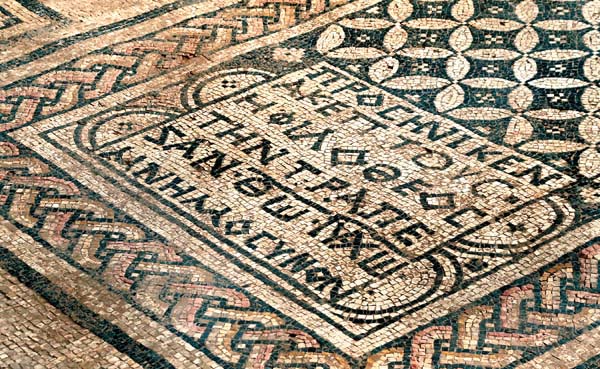
Most of these were house churches which were integrated into residential quarters. This number of house churches is typical of what archaeologists find in their excavations. It has been estimated that Christians established nearly 400,000 house churches in the first three centuries, many even after Constantine declared Christianity legal in the Roman Empire in about A.D. 313.
When Emperor Theodosius declared Christianity the official religion of the Byzantine Empire in A.D. 380, Christians made up more than 50% of the population of Syria (including parts of Turkey, Lebanon, and Jordan). By the seventh century it was 80%. As a result, in the Aleppo Plateau east of Antioch of Syria (where believers were first called “Christians” (Acts 11:26)), there is still evidence of hundreds of house churches and church buildings (these latter structures dating from the third–sixth centuries). Sadly, what was once considered the “cradle of Christianity” is no more. Recent persecution and Syrian conflicts have mostly eliminated any remaining Christian populations there.
The Response of the Church Since Then
Sweeping across centuries since the early days, has the Church continued to implement the plan of Jesus? Is it still happening – on steroids? We will explore this in the next issue of Happ-O-getics.
Sources:
Jacob Ashkenazi. “Why Did Early Christians Build So Many Churches?” Biblical Archaeology Review, 52.2 (2026), pp. 20, 22.
Sandra Scham. “The Dead Cities of Christian Syria.” Biblical Archaeology Review, 52:2 (2026), pp. 28-35.
The Bible (NASB)