This article will grow in four segments throughout 2026 to the timely and important biblical topic of the Second Coming of Jesus.
- Part 1 answers the What and Why? Originally published February 19, 2026.
- Part 2 discusses How Many Returns? (click to skip to part 2) Updated April 30, 2026
Most of the world gets up in the morning and goes to bed at night without even a thought about the Second Coming of Jesus or that He might return in their lifetimes. Some don’t even know about Him. Others don’t believe in Him. Even Christian believers may be dubious about the return of Jesus.
Part 1: WHAT We Need to Know About the Second Coming of Jesus
When Jesus was on earth physically about 2,000 years ago, He repeatedly said He would be back. The day before His crucifixion He spent the evening preparing His disciples for the crisis of His death (John 13-17). He told them, “In My Father’s house are many dwelling places; if it were not so, I would have told you; for I go to prepare a place for you. And if I go and prepare a place for you, I will come again and receive you to Myself, that where I am, there you may be also” (John 14:2-3, emphasis added).
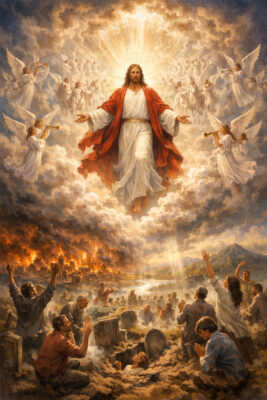
Late in His ministry, Jesus began to reveal to His followers that He was going to Jerusalem to die on the cross there, but He added, “For the Son of Man is going to come [again] in the glory of His Father with His angels; and will then recompense every man according to his deeds” (Matthew 16:27).
At Jesus’ ascension to heaven, after His resurrection, two angels affirmed His return, “This same Jesus, who has been taken from you into heaven, will come back in the same way you have seen him go into heaven” (Acts 1:11, NIV).
In His Revelation to John, Jesus introduced Himself with a promise, “I am the Alpha and the Omega… who is and who was and who is to come, the Almighty” (Revelation 1:8, emphasis added).
The apostle Peter admonished believers to “set your hope completely on the grace to be brought to you at the revelation [coming] of Jesus Christ” (1 Peter 1:13, NASB20).
The apostle Paul, near the end of his life, looked forward to receiving the “crown of righteousness” in heaven which he said would also be awarded to all “who are eagerly looking forward to His coming back again” (2 Timothy 4:8, LB).
This is just the “tip of the iceberg.” Twenty-three of the twenty-seven New Testament books make a total of 318 references to Jesus’ Second Coming. That averages out to an amazing one out of every thirty verses!
WHY Is Jesus Coming Again?
Why is Jesus coming back? The short answer is that Jesus has “unfinished business” to tend to here on earth. Specifically, there are two matters clearly stated in the New Testament.
1. The completion of His promised redemption for those who believe (blessing)
Jesus gave the indwelling Holy Spirit to those who repented of their sin and embraced Him by faith as their Savior (John 1:33; 7:37-39). According to the apostle Paul this was a pledge (“good faith deposit”) guaranteeing that He would return in the future for a “closing” to complete His redemption of believers (their “inheritance”) by taking them to heaven with Him (Ephesians 1:13-14).
The writer of Hebrews also associates final redemption with Jesus’ Second Coming: “…so Christ was sacrificed once to take away the sins of many people; and he will appear a second time, not to bear sin, but to bring salvation to those who are waiting for him” (Hebrews 9:28).
This first purpose for Jesus’ return is clearly stated in 1 Thessalonians 4:16-17: “For the Lord Himself will descend from heaven with a shout… and the dead in Christ shall rise first. Then we who are alive and remain shall be caught up together with them in the clouds to meet the Lord in the air, and thus we shall always be with the Lord.”
2. The consummation of His kingdom and the defeat of all evil (judgment)
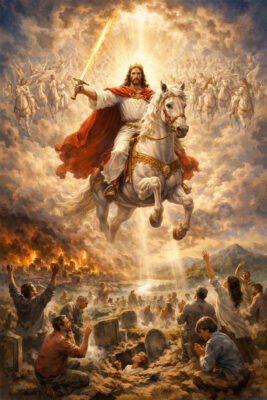
Jesus and His eternal kingdom (rule and reign) were prophesied in the Old Testament: “One like a Son of Man was coming… And to Him was given dominion, glory and a kingdom, that all the peoples, nations, and men of every language might serve Him. His dominion is an everlasting dominion which will not pass away; and His kingdom is one which will not be destroyed” (Daniel 7:13-14).
As a result, Jesus is declared to be Lord of all: “Therefore, also God highly exalted Him; and bestowed on Him the name which is above every name, that at the name of Jesus every knee should bow, of those who are in heaven, and on earth, and under the earth, and that every tongue should confess that Jesus Christ is Lord…” (Philippians 2:9-11).
After Jesus then judges and conquers every evil in the great tribulation, the Bible says: “Then the end will come, when He hands over the kingdom to God the Father after He has destroyed all dominion, authority, and power. For He must reign until He has put all His enemies under His feet. The last enemy to be destroyed is death… so that God may be all in all…”(1 Corinthians 15:24-26, 28, NIV).
The book of Revelation announces Jesus’ future final victory: “The kingdom of the world has become the kingdom of our Lord, and of His Christ, and He will reign forever and ever” (Revelation 11:15).
Jesus then describes the glories of heaven which await His own: “…and He shall wipe away every tear from their eyes, and there shall no longer be any death; there shall no longer be any mourning, or crying, or pain; the first things have passed away” (Revelation 21:4)
This is why Christians through the centuries have called the Second Coming of Jesus “the blessed hope.”
The Blessed Hope
That is a summary of the “what” and the “why” of the Second Coming of Jesus. As I continue to add to this article throughout 2026 (be sure to check back) what the Bible says about the events at the end of the world and the eternal destiny of all humanity, the Bible admonishes all believers how to live their lives: “For the grace of God that brings salvation has appeared to all men. It teaches us to say ‘No’ to ungodliness and worldly passions, and to live self-controlled, upright and godly lives in this present age, while we wait for the blessed hope – the glorious appearing of our great God and Savior, Jesus Christ…” (Titus 2:11-13, NIV, emphasis added).
Part 2: How Many Returns?
Now that we’ve answered the pretty straightforward questions of What and Why of the second coming of Jesus, what follows is a breakdown of the more controversial question: How many returns? In other words, Jesus had two matters of “unfinished business.” Is He going to return once to complete His promised redemption of believers and a second time to consummate His kingdom and judge evil? Or will He do it all at the same time in only one return? Christians are divided on this question. I will make the case for two distinct returns.
The difficulty of reconciling the biblical passages as one return
Those who support a single return identify it with the final judgment of Revelation 19:11-21, when believers and unbelievers are resurrected and judged. This comes after the seven-year Great Tribulation period filled with terror, martyrdom, and the unleashing of God’s wrath (Revelation 6-18). Can this be reconciled with other Scripture passages referring to Christ’s Second Coming?
- “For you yourselves know full well that the day of the Lord will come just like a thief in the night” (1 Thessalonians 5:2). “For the coming of the Son of Man will be just like the days of Noah…” [amid normal activities] “…and they did not understand until the flood came and took them all away” (Matthew 24:37-39). Events during the tribulation (a time of horror) which immediately precedes Revelation 19:11-21 is anything but normal and does not support a thief in the night return of Jesus!
- “…and to wait for His Son from heaven, whom He raised from the dead, that is Jesus, who delivers us from the wrath to come” (1 Thessalonians 1:10). “For God has not destined us for wrath, but for obtaining salvation through our Lord Jesus Christ” (5:9). These passages promise that believers will not experience the coming wrath of God. This is inconsistent with those who claim that believers will go through the Great Tribulation (the time of God’s wrath) before His coming as depicted in Revelation 19:11-21.
- “Therefore comfort one another with these words” (1 Thessalonians 4:18). “Now may our Lord Jesus Christ Himself…who has loved us and given us eternal comfort and good hope by grace, comfort and strengthen your hearts…” The day of the Lord (Second Coming) is being referenced in these verses. Where is the comfort and encouragement when what you have ahead of you is living through the terror of God’s wrath and likely martyrdom (as the single return view maintains)?
- “…God will bring with Him those who have fallen asleep in Jesus… For the Lord Himself will descend from heaven with a shout, with the voice of the archangel, and… the dead in Christ shall rise first. Then we who are alive and remain shall be caught up together with them in the clouds to meet the Lord in the air… comfort one another with these words.” (1 Thessalonians 4:16-17). In contrast to this return of Jesus, the Second Coming in Revelation 19:11-16 has Christ with a sword to smite the nations (judgment) and cast the antichrist and false prophet into the lake of fire.
- In 1 Thessalonians 4:16-17 the Lord’s coming is to gather up believers to Himself in the clouds with no mention of a white horse. In the Revelation 19 Second Coming, Jesus descends to the Mount of Olives (Zechariah 14:4, 8) on a white horse with sword to make war. There is darkness over the earth (Matthew 24:29; Zechariah 14:6) and the sign of the Son of Man appears in the sky (Matthew 24:30). The Second Coming mentioned in Paul’s letter to the Thessalonians and John’s book of Revelation do not appear to be the same event.
The gathering of believers to the Lord before the Great Tribulation is taught in Scripture
1. Jesus’ promise
In the Lord’s message to the church in Philadelphia, Jesus made the statement, “Since you have kept my command to endure patiently, I will also keep you from the hour of trial that is going to come upon the whole world to test those who live on the earth” (Revelation 3:10). The “hour of trial” is surely a reference to the Great Tribulation. It is likely that this promise is to all believers who will be gathered to the Lord before the Tribulation occurs.
2. The apostle Paul’s assurance
The apostle wrote a second letter to the Thessalonian believers to correct a misunderstanding which arose there:
…with regard to the coming of our Lord Jesus Christ, and our gathering together to Him, that you may not be quickly shaken from your composure or be disturbed whether by a spirit or a message or a letter as if from us, to the effect that the day of the Lord has come…
[The “day of the Lord” is the Second Coming of Jesus, especially identified with judgment] Why were they disturbed? Paul clarifies the context in verse 1: “…the coming of our Lord Jesus Christ, and our gathering together to Him…” (NASB/NIV emphasis added; [“…our being gathered together to be with Him,” TEV]). They mistakenly thought the “day of the Lord had already come” [His return] (v.2.). That would disturb them only if Paul had previously taught them that the “gathering to Him” would be the first thing to happen when Jesus returned and before the Judgment started. Thinking that the day of the Lord had already occurred, and since they probably were experiencing some persecution, they imagined it was the Judgment and that they had missed the “gathering.” They feared they had been left behind!
Paul responds: “Let no one deceive you, for it will not come [the day of the Lord in judgment] unless the apostasy comes first” (v. 3). The Greek word “apostasia” (transliterated “apostasy” in most Bible translations) is taken to mean “falling away” [KJV] or “rebellion” [NIV, TEV, NEB]. That view may not be correct. The noun form is used only once in the New Testament with that meaning (Acts 21:21 “forsake” Moses). The verb form, however, is used fifteen times and in only three cases does it refer to religious departure [“falling away”]. When it has that meaning it is also accompanied by a descriptive phrase such as “from the faith.” All the other twelve uses have the meaning “to depart” (cf. Acts 12:10: “the angel departed from him”; 2 Timothy 2:19: “depart from iniquity”; or Luke 2:37: “she never left [departed] from the temple.”) This use is likely the intention of Paul in 1 Thessalonians 2:3 – “unless the departure (gathering of us to Himself = rapture) comes first.” This reflects the context in v. 1.
Since this is the most common meaning of the word in the New Testament, and the context supports it [“gathering together to Him”], Paul here would be affirming and asserting a pre-tribulation rapture of believers – and removing the misunderstanding which was upsetting the Thessalonian believers! With this understanding, the passage would then read:
“…with regard to the coming of our Lord Jesus Christ, and our gathering together to Him, that you may not be quickly shaken from your composure or be disturbed whether by a spirit or a message or a letter as if from us, to the effect that the day of the Lord has [already] come. Let no one deceive you, for it will not come unless the departure [gathering/rapture] comes first…” (2 Thessalonians 1:1-3, emphasis added). That is why Paul can then assure them that this truth should “comfort and strengthen your hearts.” (2 Thessalonians 2:17).
Conclusion
The various passages of Scripture are best harmonized by separating the return of Jesus into two phases: a pre-tribulation gathering of believers to Himself (1 Thessalonians 4:13-18); and a post-tribulation judgment and establishment of His kingdom reign (Revelation 19:11-21).
What/Who is the “Restrainer” of Evil in the End Times?
The apostle Paul told the Thessalonian believers that prior to the revealing of the man of lawlessness (antichrist) during the Tribulation, there would be a restraint on lawlessness (2 Thessalonians 2:6-7). Only when the Restrainer (referred to as “HE” in verse 7) is taken away does “all hell break loose” (v.9) and God begins His judgment (v. 8) of the end times (seven-year Tribulation).
Many commentators believe the restraint is human government. Unfortunately, government is often part of the evil in the world, and not likely to be referred to by a personal pronoun (“He”). Furthermore, what is the likelihood that human government will depart (be taken away)?
Rather, what if the “Restrainer” is the Holy Spirit? The rapture (see “B” in the main feature) of the faithful Church/individual believers in whom He dwells would certainly remove their influence (restraint) as “salt” and “light” (cf. Matthew 5:13-16).
With the absence of the Holy Spirit, evil would have little restraint and the man of lawlessness can be revealed (set free). Satan, the antichrist, and the false prophet then lead a world rebellion (Revelation 13), and God will execute the judgments of the vials, trumpets, and bowls as described in Revelation 6-18.
It is interesting that Paul refers only to unbelievers being deceived by the satanic activities:
and with all the deception of wickedness for those who perish, because they did not accept the love of the truth so as to be saved (2 Thessalonians 2:10-12).
In contrast, with enthusiasm, he gives thanks to God for the believers’ salvation by which they “gain the glory of our Lord Jesus Christ.” He admonishes them to stand firm in what they had been taught which will result in “eternal comfort and good hope by grace” (vv. 13-17). The sense here is that their “comfort” and “good hope” is because they, having accepted the love of the truth, will already have been gathered together with the Lord (raptured) and thus not experience the deception and wrath of the tribulation.
This article will grow in four segments throughout 2026 to the timely and important biblical topic of the Second Coming of Jesus. This is the first installment. Future additions to this article will address many questions, like the following:
- When can the Second Coming of Jesus be anticipated?
- How can the believer prepare for the Second Coming of Jesus?
- Is there a rapture of believers before the great tribulation?
- What will the world be like preceding Jesus’ Second Coming?
- Is the Second Coming of Jesus in two stages?
- Why does the Bible say we are to comfort one another about the end?
- What is the millennium?
- Can I know for certain where I will spend eternity?