Israel, and especially Jerusalem, is one of the most excavated places in the world. Recent discoveries are providing powerful archaeological evidence for King David and his kingdom, offering fresh confirmation for the historical accuracy of the Bible. Although decades of research once led many scholars to question whether David was anything more than a minor tribal leader, new finds in and around Jerusalem are painting a very different picture. These discoveries help demonstrate that the biblical description of David’s reign is firmly rooted in real history, not myth.
Evidence for King David and the Kingdom of Israel in the Early Tenth Century BC
The biblical text (in the books of Samuel, Kings, and Chronicles) paints a detailed picture of King David’s life and reign over a significant kingdom of Israel in the tenth century. The lack of contemporary inscriptions mentioning David or archaeological evidence unequivocally linked to his reign at that time led to a dominant view by scholars which relegated him to the realm of myth, or that he was only a local leader who ruled over a few thousand Bedouin shepherds in the vicinity of Jerusalem. New archaeological evidence, however, is changing that perspective and in fact confirms the historical accuracy of the biblical text.
The Tel Dan Stele
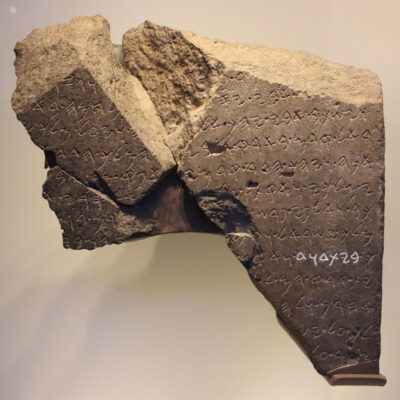
A pivotal piece of archaeological evidence for King David was unearthed in Northern Israel: the Tel Dan Stele. This ninth-century BC victory stone, inscribed by an enemy nation, specifically mentions the “House of David” (Beth David). As the first widely accepted extra-biblical reference to the House of David, this discovery shattered the “mythological” view of the monarchy. It provides a concrete, historical anchor for the historical accuracy of the biblical narrative, proving that even Israel’s enemies recognized David’s lineage as a formidable and established royal dynasty. This find remains a cornerstone for scholars seeking to reconcile the written Word with the physical remains of the ancient Near East.
Archaeological Evidence for King David: Context
Excavations of five cities close to Jerusalem reveal fortification and evidence of an elaborate model of urban planning dating to the traditional time of David (~1000 BC). This research provides strong archaeological evidence for King David by making the compelling case for an organized tenth‑century BC kingdom in Judah (and later, Solomon and his son Rehoboam), comprised of interconnected cities which display parallel construction features, material culture, and a similar carbon‑14 (C14) date range.
Dating Biblical Jerusalem
Since 2014, more than a hundred radiocarbon samples from the City of David excavations have revealed eighteen which fall within the early Iron Age (twelfth-tenth centuries BC). Such a large number clearly supports the existence of widespread human activity on Jerusalem’s southeastern ridge (The City of David) during the time period indicated by the Bible for David’s reign there.
Defense: Rock-cut Moat
A manmade ditch carved down through the bedrock has been discovered in Jerusalem, measuring nearly 100 feet wide and 30 feet deep. It extends across the entirety of the northern part of the City of David, separating the area of the Temple Mount and the Ophel in the north from the City of David ridge to the south. Jerusalem during David’s reign occupied only the elevated southeastern ridge (close to the Gihon Spring), protected by valleys on the east, south, and west, but still vulnerable to the north. This rock‑cut moat filled that gap by providing the crucial northern defense. Evidence from C14 dating points to its creation in the early Iron Age— as early as the 10th century BC—consistent with the traditional time of David’s reign and with the fortified Jerusalem described in Scripture. With the subsequent building of the Temple on the Mount by David’s son Solomon, and with the growth of Jerusalem in the ninth and eighth centuries BC, the moat’s steep‑sided scarps seriously limited movement between the City of David and the Temple Mount, as well as to the expanding city to north and west. The moat was gradually filled and covered with construction over the centuries which resulted in its disappearance until it was discovered again in 2019.
Archeological Evidence for Continuation of the Kingdom of David into the Ninth and Eighth Centuries
It is not only tenth-century Jerusalem and David’s kingdom which are being confirmed. Archaeologists now agree that new evidence supports the continued existence and expansion of Jerusalem over the next two centuries.
Tyropoeon Valley Dam
Recent excavations in the City of David Archaeological Park discovered an ancient dam, the largest ever discovered in Israel, measuring 40 feet high and 26 feet thick. Water flowing down the Tyropoeon Valley was captured as a ready source of water during periods of low precipitation while also protecting against flash flooding during heavy rains. Radiometric analysis dates the dam’s construction to the late ninth century BC, perhaps during the reigns of Kings Joash and his son Amaziah (1 Kings 12). This suggests Jerusalem was an expanding city with a growing population.
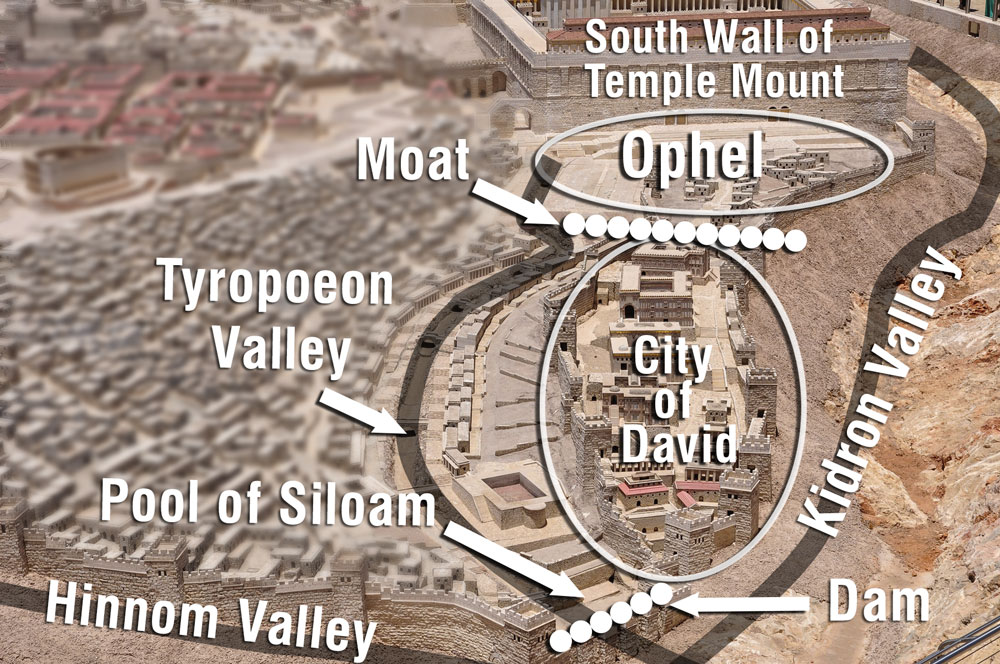
From a model of first century Jerusalem, the view looking north at the City of David. The moat south of the Ophel; the dam on the southwest corner of the City of David; and Tyropoeon Valley to the west, are shown.
Gihon Spring Tower and Wall
In the early 2000s, a fifteen‑year‑long excavation at the Gihon Spring discovered the remains of a large tower and a significant wall along the Kidron Valley, just below the southeast ridge of the City of David. This massive fortress—sometimes called the “Spring Citadel”— protected Jerusalem’s main water source with walls over twenty feet thick. Earlier studies identified this as a Middle Bronze (Canaanite) stronghold, and more recent radiocarbon tests show a major fortification phase in the late ninth century BC, when the kings of Judah were turning Jerusalem into a heavily defended capital. The Bible later records that King Hezekiah strengthened Jerusalem’s walls and secured the Gihon’s water during the Assyrian threat (2 Chronicles 32:1–5, 30)—events which took place around 700 BC—exactly the kind of activity we would expect in a city with such massive, long‑used defenses around its spring, affirming the reliability of God’s Word and the biblical account of Hezekiah’s preparations.
Hezekiah’s Tunnel
The Bible states (2 Chronicles 32:30, NIV), “It was Hezekiah who blocked the upper outlet of the Gihon spring and channeled the water down to the west side of the City of David” (to the Pool of Siloam). The channel had to be tunneled through bedrock. Radiometric dating of organic material in the tunnel’s plaster, together with the eighth‑century Hebrew script of the Siloam Inscription, points to a construction date around 700 BC—precisely the time of King Hezekiah and the Assyrian invasion described in 2 Chronicles 32—affirming the reliability of God’s Word. Today, this seemingly impossible engineering feat can be experienced by many tourists in Jerusalem who observe it or even wade through it!
Earthquake
The prophet Isaiah identified the time of his prophecy regarding Israel to have been “in the days of Uzziah king of Judah” and “two years before the earthquake” (Amos 1:1). Uzziah ruled in the mid-eighth century. Indeed, destructive layers from the earthquake have been found at major sites across Israel, including Megiddo and Hazor, but no traces of this had ever been discovered in Jerusalem. In 1918, a building was exposed on the eastern slope of the city which had suffered a severe destruction – in the mid-eighth century. In examining earlier reports of archaeological digs around the city, it has become clear that other areas of Jerusalem were also destroyed around the same time. Again, this provides confirmation that the historical references in the Bible can be trusted.
Conclusion
King David’s reign laid the foundation for Israel’s golden age under his son Solomon. His reign was characterized by military success and the expansion of Israel’s borders. He captured Jerusalem from the Jebusites and established it as his capital, known as the City of David (2 Samuel 5:6-9). David’s military campaigns subdued the Philistines, Moabites, Ammonites, Edomites, and Arameans (2 Samuel 8). This was a fulfillment of the promise of land God promised to Abraham (Genesis 17). David is also the central figure in the lineage of Jesus Christ, the promised Messiah.
All these finds, most of which have been made within just the past few years, provide compelling archaeological evidence for King David and continue to affirm the legitimate biblical history of Israel, the centrality of Jewish Jerusalem, and the accuracy of the Scriptures.
Sources:
- Yuval Godot, et.al., “A Decade of Discoveries in Biblical Jerusalem.” Biblical Archaeology Review 51.1 (2025), pp. 46-53.
- “Dam of Biblical Proportions.” Biblical Archaeology Review 51.4 (2025), p. 11.