About the Series
This video series is primarily intended to help a Christian believer build a Biblical foundation for Christian spiritual growth and a lifelong relationship with God. You will discover principles for maintaining a dynamic Christian faith including abiding in Christ, dependence on the Holy Spirit, and resisting the schemes of the devil. You will also develop the disciplines for experiencing victory in the Christian life including prayer, Bible study and fellowship with other believers. This series also includes small group discussion questions and Scripture memory verses and daily Bible readings. A ‘hands-on’ experience.
To go further in depth, you can purchase the student manuel or download a digital version here.
Application Ideas
- Personal Growth & Study
- Small Group or Sunday School
- Classroom Christian Education
- Home Schooling
Part 1

Part 3.2
Part 5.2
Part 7.2
Part 2
Part 4
Part 6
Part 8
Part 3.1
Part 5.1
Part 7.1

Small Group Study and Discussion
GROWING FAITH – Discipleship for New and Not-so-New Believers
This discipleship video series consists of eleven recordings totaling 393 minutes. Each part is based on a chapter in a text/workbook by the same title. The video sessions and lengths are summarized below:
- Fresh and New: Experiencing Life from Above (31:50)
- Faithful and True: Experiencing Stability in the Christian Life (37:52)
- Planning to Build: Spiritual Resources and Obstacles Pt.1 (36:15)
- Planning to Build: Spiritual Resources and Obstacles Pt.2 (38:20)
- Prayer: Talking and Listening to God (32:14)
- Staying in Relationship: Assurance of Forgiveness Pt.1 (43:03)
- Staying in Relationship: Assurance of Forgiveness Pt.2 (33:12)
- Spiritual Guidance: God’s Spirit Given to Us (32:16)
- Hindrances to Growth: Victory over Spiritual Opposition Pt.1 (30:58)
- Hindrances to Growth: Victory over Spiritual Opposition Pt.2 (33:54)
- Body Life: Encouragement and Support Around Us (43:25)
The key purposes and discussion questions are provided in this guide for each of the eleven video sessions. A suggested session sequence for facilitation is itemized below.
Support resources are also available (FaithSearch online store: shop.faithsearch.org)
- Growing Faith Discipleship Student Manual, 80 pages
- Growing Faith Leader’s Guide (Planning Guidelines; Lesson Plans; Answer Keys for the Student Manual), 56 pages
Suggested Session Sequence for facilitating Growing Faith videos in small groups
- Open in prayer.
- Introduce the video series to your group (a recommendation has been included in this Guide immediately before the first session below).
- Introduce the video for the current session including the purposes.
- Watch the current session video segment.
- Interact with your group by responding to their questions and also using the questions provided for discussion. The author’s thoughts are also provided for each discussion question to give you and your group additional insight.
- Announce the next session in the series.
- Close your time with prayer.
Start here for your small group. Use the quick links below to quickly scroll down to your next session.
A suggested introduction of the Growing Faith video series to your group
Growing Faith will help a Christian believer to build a Biblical foundation for spiritual growth and a life-long relationship with God. You will discover principles for maintaining a dynamic Christian faith including abiding in Christ, dependence on the Holy Spirit, and resisting the schemes of the devil. You will also develop the disciplines needed for experiencing victory in the Christian life including prayer, Bible study, and fellowship with other believers. Each lesson is intellectually and spiritually challenging, yet provides a ‘hands-on’ experience with Scripture memory verses and daily Bible readings. Be prepared to expand and deepen your understanding of the Christian faith.
Growing Faith – Discipleship for New and Not-so-New Believers
Click a session to begin.
1. Fresh and New: Experiencing Life from Above
2. Faithful and True: Experiencing Stability in the Christian Life
3. Planning to Build: Spiritual Resources and Obstacles (Part 1)
4. Planning to Build: Spiritual Resources and Obstacles (Part 2)
5. Prayer: Talking and Listening to God
6. Staying in Relationship: Assurance of Forgiveness (Part 1)
Session One: Fresh and New: Experiencing New Life from Above
VIDEO play time – 38 minutes
Purposes
- To explain the Biblical basis for becoming a Christian.
- To identify what is new as a result of becoming a Christian.
Key Point: Becoming a Christian is to become a new creation.
“Niceness: …is an excellent thing… But we must not suppose that even if we succeeded in making everyone nice we should have saved their souls. A world of nice people content in their own niceness, looking no further, turned away from God, would be just as desperately in need of salvation as a miserable world – and might even be more difficult to save.
For mere improvement is no redemption, though redemption always improves people even here and now and will, in the end, improve them to a degree we cannot yet imagine. God became man to turn creatures into sons: not simply to produce better men of the old kind but to produce a new kind of man.” C.S. Lewis, Mere Christianity (New York: Macmillan, 1978), p. 182.
Session 1 Q&A
Group Discussions and Reflection Questions.
Click each question to read the Author’s Thoughts.
1. Discuss the quote by C.S. Lewis above. Include in your discussion why it is so common for unbelievers (even Christians!) to equate becoming a Christian with morality (niceness).
Author’s Thoughts: Jesus’ conversation with Nicodemus (John 3:1-8) gives insight into the difference between “religion” (niceness) and “relationship” (new creation). He told this religious leader that he was not going to heaven unless he was “born again” (literally “conception from above”). This was not a reference to being “holier than thou” but rather the miracle of spiritual regeneration when the Holy Spirit enters a person (Titus 3:5; John 14:16-17; 1 Corinthians 2:12; 3:16; 6:19). This is stated as a new creation in 2 Corinthians 5:17. The next question answers how we can know we have the indwelling Holy Spirit.
2. How can I have assurance that I am a Christian?
Author’s Thoughts: We must reject the common caricatures for assurance, namely “I believe in God,” “I’m a good person,” and “I attend church and pray.” Instead, the Bible gives several promises that are all based on faith, the most familiar may be John 3:16. Both John the Baptist and Jesus emphasized both repentance and faith (Mark 1:4, 15). That is probably assumed in the promise of Romans 10:9-10. When Jesus was introduced by John the Baptist he identified two ministries of Jesus: 1) He takes away the sin of the world (John 1:29), and 2) He baptizes in the Holy Spirit (v. 33). Anyone who sincerely professes repentance of sin and faith in Jesus Christ can have assurance that he is a Christian (John 5:24; 6:40; Acts 2:38; 16:30-31; Romans 8:1-2, 9). In the next session I distinguish between “feelings” and “facts” as it relates to assurance. One’s personal assurance of salvation (being a Christian) must be based on acceptance of the facts (truth) of the Bible.
3. What does the Bible say became new when I became a Christian?
Author’s Thoughts: There could be many things mentioned here, I would summarize with four new things. One, all our sins are forgiven (Colossians 2:13). Two, we become a child of God (John 1:12-13). Three, we receive the gift of eternal life in heaven (1 John 5:11-13). Fourth, the Holy Spirit lives within us to guide and help (John 14:15-17). These new things are immediate. What is at times frustrating is that we don’t experience these changes in our thinking and behavior automatically and at once. Thus, our spiritual enemy uses that to cast doubt on its reality and our salvation. That’s when we must apply the spiritual armor that God provides (Ephesians 6:10-18).
4. Based on the teaching in this session, discuss whether becoming a Christian is more of a “reformation” or a “transformation”? Likewise, is it more like “remodeling an old house” or the “metamorphosis of a caterpillar into a butterfly”?
Author’s Thoughts: Becoming a Christian is not a remodeling but a new creation. The four new things mentioned above were not a process but the result of a creative act of God. It is not the old improved but the existence of something new that didn’t exist before. Of course there are gradual changes as well. This is referred to in theology as “sanctification.” This has to do with “being a Christian” and not “becoming a Christian.” I like to tell my students that we are already perfect as a result of our redemption in Christ, but we are not perfect in our behavior. Thus, the challenge is to “become (in practice) what you are (in position).
5. What are some common ways you think people avoid dealing with, or are distracted from, the issue of ultimate purpose and meaning in life?
Author’s Thoughts: Many have immersed themselves in materialism, temporarily substituting “things” for any thought of God or ultimate purpose in life. Others seek an ecstatic experience, Eastern mysticism, or the use of drugs and other substances to fill the void. Some commit all their waking hours to their work or activities, never pausing long enough or daring to think whether life is ultimately meaningful (Work cycle in SBF – pp. 19-20). The lack of personal worth and ultimate meaning is probably widely felt but seldom articulated clearly. People don’t know why they are unhappy, unfulfilled, or restless. It seems not to be a significant concern so long as life is going well and the person is not faced with suffering, a broken relationship, a financial crisis, or aging issues.
People who are hurting physically, emotionally, and spiritually most often ask in exasperation, “Why?” Suicide cases may at times be extreme examples of those who struggle with purpose and meaning. Daily boredom, alcoholism, drug experimentation, occult activity, and new-age fascination may all be symptoms of a lack of purpose and meaning for people.
Session Two: Faithful and True: Experiencing Stability in the Christian Life
VIDEO play time – 32 minutes
Purposes
- Establish the Bible as the authority in life and practice for the Christian.
- Reinforce the truth that Christian faith is rooted in facts and not feelings.
Key Point: Spiritual stability, not peaks and valleys, is God’s intention and provision for believers.
Session 2 Q&A
Group Discussions and Reflection Questions.
Click each question to read the Author’s Thoughts.
1. To illustrate the factual nature of Christian faith, ask your group to look up the following Bible passages to answer these questions: (a) In the first session, how did you learn what new changes have come into your life? (b) Whose words does the Bible claim to contain? (2 Timothy 3:16a; 1 Thessalonians 2:13.) (c) Can God lie? (Titus 1:2.)
Author’s Thoughts: The purpose for question one is to establish the authority of God’s word. The sequence above should be answered as follows: (a) the changes were stated in the Bible; (b) the Bible claims to be God’s word; (c) God cannot lie. Thus, the conclusion is: Because God cannot lie, and because His words are recorded in the Bible, we can be certain that God’s promises recorded in the Bible are true.
2. Use Revelation 3:20 to illustrate the factual nature of faith. (a) Who is knocking? (b) What is the door at which He is knocking? (c) Have you opened the door of your heart to Him? (d) What does Jesus promise to do? (e) Is this true? How do you know? (f) Where is Jesus right now?
Author’s Thoughts: The sequence above should be answered as follows: (a) the Lord Jesus; (b) figuratively, the door of my heart or will; (c) personal response – if yes, this should include acknowledging and repenting of sin and turning in faith to Jesus; (d) He will come in to us resulting in a restoration of our relationship (fellowship) with God; (e) yes it is true – it is God’s word and God cannot lie; (f) in my heart and life.
3. Use 1 John 1:9 to further illustrate the importance of relying on the facts of God’s word. (a) What are we to do? (b) Have you done that? (c) What does God promise to do in return? (d) Is this promise true? How do you know? (e) What is the condition of your sins right now?
Author’s Thoughts: The sequence above should be answered as follows: (a) we are to confess our sins; (b) personal response – if yes, it would include a time of repentance and confession of faith; (c) He will forgive my sins and cleanse me; (d) yes – it is God’s word and God cannot lie; (e) I am forgiven, my sins are gone.
4. Place the following sequences where your group can see them. Think of the components as cars of a train. Which of the three is the correct sequence for stability in the Christian life? What is the danger when feelings (c) serve the role of the engine? (a) Faith car – Feelings caboose – Fact engine; (b) Facts engine – Faith car – Feelings caboose; (c) Feelings caboose – Facts engine – Faith car.
Author’s Thoughts: The correct answer should be (b) – our faith is based on Biblical facts and results in feelings of peace, fulfillment, and confidence.
5. Are you easily tempted to doubt your faith on the basis of mood swings, circumstances, or societal pressure? Discuss, based on what you have learned in this session, what plan of action might you take to counteract that tendency?
Author’s Thoughts: First, remind yourself regularly that God exists (Hebrews 11:6), that He cares for you (1 Peter 5:7), that He is working for good in our lives if we love Him (Romans 8:28), and that He limits temptations and provides an answer for victory (1 Corinthians 10:13). Continue with this approach to seek first His righteousness (Matthew 6:33), His word (John 17:17), and His fruit (Galatians 5:22–25). Stop trying to “perform” the Christian faith. Rather, celebrate your new self and yield to the power of the Holy Spirit (Colossians 3:1–17).
Session Three – Planning to Build: Spiritual Resources and Obstacles (Part 1)
VIDEO play time – 36 minutes
Purposes
- To identify where our lives have been before Christ, in contrast to the goal God has for us as believers.
- To understand the nature of spiritual growth as spiritual warfare.
- To choose and apply our newness of life to all our life circumstances.
- To become keenly aware of the opposition and obstacles to spiritual victory and growth.
Key Point: God’s plan for our lives is to build us progressively into the likeness of our Savior.
Session 3 Q&A
Group Discussions and Reflection Questions.
Click each question to read the Author’s Thoughts.
1. Discuss Jesus’ use of building a tower (Luke 14:28-30) as an illustration of the Christian life. What is the foundation He referred to? How are John 10:10 and 1 Peter 1:13-16 relevant to the discussion?
Author’s Thoughts: The foundation is faith in Jesus Christ. The tower God wants to build is abundant life. Peter is identifying some characteristics we need to implement for building that tower.
2. Use 2 Corinthians 3:18 and 1 Peter 1:16 to discuss God’s goal for our lives as Christians. Who is the source for this transformation? What kind of “tower” do I want to be made into? How does that compare with what God wants to make of me?
Author’s Thoughts: The goal God has for our lives to be like the Lord Jesus in holiness (righteousness). The Holy Spirit is the source for that transformation. Each person will have to give a personal answer to the kind of tower they had in mind and how it compares with God’s goal.
3. Discuss Ephesians 2:1-3 and 2 Corinthians 4:3-4. Ask your group whether they really accept that this was their condition before they became new in Christ? Discuss how this should affect our attitude and motivation toward unbelievers (2 Timothy 2:24-26).
Author’s Thoughts: It is common among Christians to downplay their spiritual bondage before they were redeemed through faith. It is also common to think that their current righteousness is of their own doing. As a result, they are unable to think of anything that has become new since the Holy Spirit came into their life. An understanding and acceptance of our “lostness” before Christ should make us realize that the unbeliever is not our enemy – they are victims of our enemy Satan (even as we ourselves once were). As a result, we can have more compassion and patience as we witness to them.
4. Discuss the following Bible passages as they relate to the hindrances and obstacles to spiritual growth (temptation, sin, and Satan): 1 John 2:15-17; 2 Corinthians 2:11; James 1:14-15; 1 Peter 5:8.
Author’s Thoughts: Hindrances will be studied in greater depth in a later session. For now, discuss how these obstacles can impact which response we make, whether to God’s truth or Satan’s lies.
Session Four – Planning to Build: Spiritual Resources and Obstacles (Part 2)
VIDEO play time – 38 minutes
Purposes
- To identify four resources God has provided for spiritual growth.
- To introduce the “Battle of the Will” diagram to emphasize the importance of choices we make in life situations.
- To deepen our understanding and application of the four resources God has provided for victory in the Christian’s life.
- To remind us again that we need to be alert to the spiritual forces of opposition to our faith.
Key Point: God has provided valuable resources which, if utilized, will result in spiritual growth and victory in life.
Session 4 Q&A
Group Discussions and Reflection Questions.
Click each question to read the Author’s Thoughts.
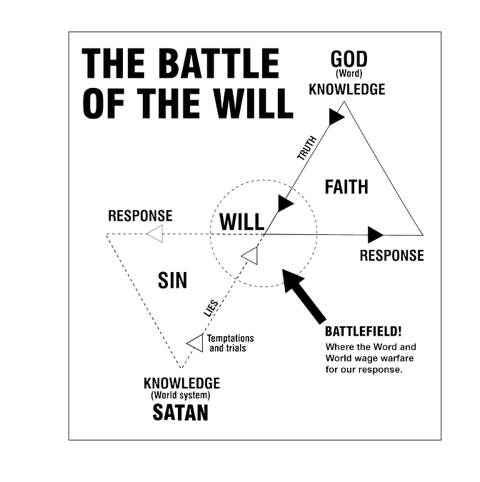
1. Use the “Battle of the Will” diagram to discuss the meaning of this statement: “The will is the battlefield where the Word and the World do warfare for your response.” Is this a spiritual battle (Ephesians 6:10-18)?
Author’s Thoughts: Indeed, spiritual growth is warfare. The illustration indicates that our choices in life are often between God’s truth (His Word) and the world’s (Satan) lies. Our response (choices) will either result in faith (upright triangle) or sin (inverted triangle) – obedience or disobedience to God’s Word (Romans 14:23b).
2. Use John 17:17, John 8:44, and James 4:7 as a basis for discussing at what points in the diagram Bible study, prayer, sensitivity to the Holy Spirit, and fellowship with other believers play a role toward the goal of spiritual growth and maturity.
Author’s Thoughts: There are many places where these resources make a difference. For example, the Holy Spirit helps us to understand God’s Word and convicts us when we sin. Prayer gives us courage in spiritual warfare and often discernment when tempted. Bible study helps us to discern God’s truth from Satan’s lies and gives insight into God’s character. Fellowship with the body of Christ can be a source of encouragement and timely counsel as well as gifted instruction in God’s Word.
3. Have your group reflect on 2 Corinthians 2:11 based on the knowledge, will, and response components of the “Battle of the will” diagram. Discuss the idea that Satan’s strategy is as a “spoiler,” seeing what God’s plan for the believer is and trying to spoil it.
Author’s Thoughts: Most people will understand that Satan’s schemes are based on deception. But he can deceive us at different levels; for example, give us counterfeit knowledge, distract our will, and incite a disobedient response. Any of these will lead to the inverted “sin” triangle rather than faith. If we keep our eyes fixed on Jesus (Hebrews 12:1-2) and put on the full armor of God (Ephesians 6:10-18), it will be difficult for Satan to spoil God’s plan for our lives (James 4:7).
4. Have your group reflect on the question: “Do I believe that by merely seeing me, God would break into a run and embrace me?” Discuss how the different answers may be dependent on the nature of each person’s relationship with God.
Author’s Thoughts: The answers here will be personal. While we respect the majesty and uniqueness of God, it may be instructive to share John 15:12-15 and Hebrews 2:11 for another dimension of God’s perspective toward His disciples. Discuss whether each person views and experiences God as a “friend.”
Session Five – Prayer: Talking and Listening to God
VIDEO play time – 32 minutes
Purposes
- To introduce a simple structure (ACTS) as a pattern for prayer.
- To establish a prayer life based on a personal relationship with God.
- To encourage both talking and listening in times of prayer.
Key Points:
- Prayer is not a chore or duty but communication between members of a family who love each other (God and us).
- A prayer life is a privilege, sustains the soul, and provides access to Divine power to meet our needs.
Session 5 Q&A
Group Discussions and Reflection Questions.
Click each question to read the Author’s Thoughts.
1. God has made it clear that the “prayer of the upright pleases Him” (Proverbs 15:6) and that we have a 24/7 invitation to spend time with Him, our Creator. The Bible even says to “pray without ceasing” (1 Thessalonians 5:17). In light of this, discuss some reasons why so many Christians admit they spend little time in prayer.
Author’s Thoughts: First, the Bible does not mean that we are to maintain non-stop speaking. Rather, we are always to maintain an attitude of dependence and awareness of God, a conscious connection with God. Regarding why we might not do that, it may often be because we have not cultured a relationship with God. We have little experience of His love, His sacrifice for us, our adoption into His family, His hearing us (Proverbs 15:29), etc. In the last session we identified the four resources God has provided for spiritual growth and victory – the Bible, the Holy Spirit, prayer, and fellowship with other believers. If we are not actively pursuing these, it is unlikely we will get “close” to God. When we love God, we will want to spend time talking and listening to Him.
2. Have your group read Romans 8:26-39. Have them identify several of the truths there about God’s care for His adopted children. What does 1 Peter 5:7 add to these?
Author’s Thoughts: The Romans passage indicates several ways God is active in our lives. 1) the Holy Spirit intercedes God’s will for us when we are too weak to do so (vv. 26-27); 2) God is working in our circumstances for good (v. 28); 3) He is not an opponent but a friend (vv. 31-34); 4) Nothing in all creation can separate God’s love from us. The apostle Peter adds that we should cast all our cares upon Him because “He cares for you.” The night before Jesus was crucified, He told His disciples that He “calls them friends” (John 15:12-15). That is the goal in our relationship with God. Without that, it is difficult to maintain a “pray without ceasing” consciousness.
3. Have your group read the following passages: Mark 14:36; Romans 8:15; Galatians 4:6. What word do they have in common? What is the significance of this word to the subject of prayer?
Author’s Thoughts: The word used in all these verses is “abba” from the Aramaic language. It is equivalent to the informal “daddy” in English. It is only used in the New Testament as a salutation to God in prayer. That should speak volumes to us about God’s view of our relationship with Him. According to Galatians 4:6, it is the Holy Spirit Himself within us who leads us in that salutation – as a child to his daddy!
4. Read the following passages and discuss how they provide the strongest argument for the importance of prayer: Luke 5:16; 6:12; 9:18, 28; 18:1; 22:44.
Author’s Thoughts: Jesus set an example by practicing prayer in His life and ministry. He also taught it (Luke 18:1). Not only was it one of the deepest habits of His daily life, but He was found praying at all the crises of His life: baptism (Luke 3:21); choosing the twelve apostles (Luke 6:12); in the garden of Gethsemane before His arrest; and at His death (Luke 23:46).
5. Discuss the following statement: “Prayer is an opportunity for praising God.”
Author’s Thoughts: Petitionary prayer eliminates crediting coincidence for events in our life. Regular communication with God regarding our desires and needs would link the fulfillment of those desires and needs with God. In other words, asking in prayer helps us recognize God’s activity in our lives and we praise Him for it.
6. Sometimes we make prayer too difficult. Introduce a structure for time with God that keeps it simple: “A” – adoration (1 Chronicles 29:11); “C” – confession (1 John 1:9); “T” – thanksgiving (Ephesians 5:20); “S” – supplication [requests] (Matthew 7:7). Without bowing heads, ask your group to suggest statements of adoration, then confession, then thanksgiving, and then requests.
Author’s Thoughts: “ACTS” may not always be the structure used in prayer, but for the beginner it is important to recognize that prayer is more than a “gimme” attitude. There is “fellowship” with God in our communication times. ACTS also removes the uncertainty of “what should I say” in my prayer time. Finally, ACTS establishes a manageable habit. Its time limitation will be inadequate as the believer grows but the habit will continue. In future times of group prayer, you may want to “guide” the time by directing people to focus on one letter at a time; for example, have everyone focus on adoration, then confession or thanksgiving, etc.
Session Six- Staying in Relationship: Assurance of Forgiveness (Part 1)
VIDEO play time – 43 minutes
Purposes
- To explain the redemptive role of guilt in the Christian’s life.
- To identify the nature of, and the reasons why, we sin.
- To clarify the components of genuine repentance.
Key Points:
- Sin is not only what a person does, but also what a person is.
- Genuine guilt alerts us to the causative reality of sin in our lives. It does for the heart what pain does for the body. Guilt’s goal is to direct us to Jesus for forgiveness.
- The biblical meaning of repentance includes confession, contrition, and correction – a change of mind resulting in a change of life.
Session 6 Q&A
Group Discussions and Reflection Questions.
Click each question to read the Author’s Thoughts.
1. Discuss one aspect of sin expressed in this statement: “Sin is not something that a person does, but something a person is.” Reference these passages in your discussion: Jeremiah 17:9; John 3:19-20; 15:18-23; Romans 3:9-12; 5:8, 12, 15; Ephesians 2:1-3.
Author’s Thoughts: The focus in this question and passages is the sin nature, the fallen state of unrighteousness we are conceived in. It is for this reason that Jesus became incarnate to redeem us from our lostness in sin (1 Timothy1:15; Romans 5:15, 18-19; Ephesians 2:4-7). Discussion of this question is a good opportunity to remind everyone in your group of the need for a recognition that our righteousness before God is entirely a gift (grace) and not the result of our works (Ephesians 2:8-9; Titus 3:5-7). In theology, this is referred to as “justification.” Repentance of our sinful state and confessed faith in Jesus as Savior is the only means of salvation from our sin nature (Acts 4:12).
2. Discuss the reason that Adam and Eve hid from God (Genesis 3:8). Was this genuine or false guilt (see v. 11)? How can you tell the difference (see Romans 7:7-13; Colossians 2:16-23).
Author’s Thoughts: It is clear that Adam and Eve had disobeyed a command of God – it was true moral guilt. The apostle Paul says that the law defined the righteousness of God and thus revealed unrighteousness in our thoughts and behavior. This genuine guilt is not meant to “beat us up,” but rather to direct us to God for forgiveness (1 John 1:9). We are not to hide when we sin but rather to run to God and seek His mercy and grace. On the other hand, the demands identified in Colossians 2:16-23 are “man-made” to control and torment our conscience without any escape.
3. Jesus’ redemption of us from our sin nature removes the penalty of sin (Justification; Romans 8:1-2), but there is still the issue of the power of sin that lingers in daily living (referred to in theology as “sanctification”). Discuss the ways we may sin and the sources of that sin. Reference the following: 1 John 2:16; James 1:14-15; Romans 13:14; 2 Corinthians 11:3, 13-14; Proverbs 22:15; John 8:44; Genesis 2:16-17; 3:11-13.
Author’s Thoughts: This question reveals that the ways in which we commit sin are several. You might ask your group to imagine a target with a bullseye and concentric rings extending out. Sin might be illustrated by an arrow (our intentions) shot at the target that “falls short” of the target or veers off to the left or right. That cause may be immaturity or imperfection. You are trying but not able to hit the target, much less the bullseye. With this kind of sin we need to be encouraged to have patience and in time acquire biblical knowledge and spiritual maturity. A three-year-old child is not expected to have the skill of a teenager. On the other hand, there is the person or occasion where we reject the target entirely. We don’t accept the Bible’s authority or truth. This is the sin of rebellion (willful sin). It is not just our aim that may be a problem but our motive as well. You might use the fruit of the flesh versus the fruit of the Spirit (Galatians 5:19-25 and the lifestyle of the “new self” in Ephesians 4:17-32 to illustrate God’s will for His redeemed children. Regarding the sources of sin, the passages above identify the world system, the flesh, and the devil. There are several manifestations of these in the passages given.
4. One of the key points above identifies the three components of repentance (the three “C’s”). Use the following passages to illustrate these components: Luke 15:21; 22:60-62; 19:1-10; Psalm 41:1-17. Discuss which of the three is the most difficult for each person.
Author’s Thoughts: A simple description of repentance is that it is a change of mind resulting in a change of life. Confession, contrition, and correction define a genuine repentance versus a counterfeit response which wants only to avoid the consequence of our sin.
Session Seven – Staying in Relationship: Assurance of Forgiveness (Part 2)
VIDEO play time – 33 minutes
Purposes
- To identify the root meaning of forgiveness.
- To explain the vital role of repentance and forgiveness to maintain fellowship with God.
- To reveal Jesus’ example for forgiveness as we interact with one another in the body of Christ.
Key Points:
- We should never hide from God when we sin but rather go boldly to Him in confession and repentance. He promises to forgive.
- Our forgiveness is possible because Jesus shed His blood on the cross to pay the penalty for our sin and death.
Session 7 Q&A
Group Discussions and Reflection Questions.
Click each question to read the Author’s Thoughts.
1. Discuss how the root meaning of forgiveness (“to send off”) relates to God’s demeanor toward our sin, and also this quote from Larry Richards: “In the New Testament, ‘guilt’ is mentioned only six times – and only sixteen times in the Old. But sixty times in the New Testament alone God speaks of forgiveness. In most of those cases, forgiveness is directly related to sin, which is the root of guilt. God doesn’t only deal with guilt, the result. In Christ he has dealt decisively with sin, the cause!”
Author’s Thoughts: We remove our finger from a hot stove not only to stop the pain, but also to prevent being severely burned – to have or restore health to that finger. Likewise, we run to God not just to get rid of guilt (the result of sin) but mostly to remove the cause itself. God “sends sin off,” with mercy forgives, sending it “as far as the east is from the west” (Psalm 103:11-14). His attitude (demeanor) is indicated in Psalm 86:5 – “good,” “ready to forgive,” and “abundant in mercy” to them who call upon Him.
2. Discuss how God’s forgiveness is only possible because of the sacrifice of Jesus on the cross. Look up these passages in your discussion: Psalm 49:7-9; Mark 10:45; Hebrews 9:22; Romans 5:8-9; 1 Peter 2:24; 3:18.
Author’s Thoughts: God is love, but He is also just. By His love He cannot “wink away” or ignore the seriousness of sin – that would violate His justice. But Jesus, the only human without sin, shed His blood (the ransom paid) as our substitute to satisfy God’s justice, freeing Him to exercise His mercy and forgive us.
3. Discuss: Can an act of sin be so great that God cannot forgive. Consult Isaiah 1:18.
Author’s Thoughts: It has been said that there is no sin, but what God’s grace is greater still. What about the unforgiveable sin that Jesus talked about (Matthew 12:31-32). The key here is Matthew 12:24 where the Pharisees claimed that the work of the Holy Spirit was the work of Satan. This blasphemy was not an “act of sin” but rather the removal of the “means” of forgiveness. Jesus said it is the Holy Spirit who gives life (John 6:63). He told Nicodemus that he wasn’t going to heaven unless he had new life by the Holy Spirit (John 3:5-6). The Pharisees removed the only path to forgiveness, which is why it was unforgiveable. If they repented of that blasphemy and acknowledged their error, the path would again be open and forgiveness granted.
4. Discuss the “standard” given in the New Testament for our forgiveness of one another. Consult Ephesians 4:32; Matthew 6:12, 14-15; 18:21-22.
Author’s Thoughts: The quote of C.S. Lewis (“Everyone says sin is a lovely idea, until they have something to forgive”) and the story of Corrie Ten Boon meeting and forgiving a former cruel guard, certainly reveals that forgiveness is not always easy. The key, however, is that Jesus’ forgiveness of us wasn’t easy for Him either – but He is the “standard.” We didn’t deserve forgiveness. Forgiveness is rooted in grace. That’s why Jesus could say to Peter’s question: “Don’t count!”
Session Eight – Spiritual Guidance: God’s Spirit Given to Us
VIDEO play time – 32 minutes
Purposes
- To understand that we have value and that God fully accepts us though we may face frustration when we fail and experience incompleteness.
- To identify the various roles of the Holy Spirit in the Christian’s life.
- To reflect on the reality of the Holy Spirit’s presence in our lives.
Key Points:
- The Christian life is not a dash, but a marathon, and victory in the Christian life is not necessarily coming in first but sustaining a vital relationship with Jesus so we can finish strong.
- The indwelling Holy Spirit is indispensable to attain God’s intent for our lives.
Session 8 Q&A
Group Discussions and Reflection Questions.
Click each question to read the Author’s Thoughts.
1. How can a believer be certain the Holy Spirit actually indwells them?
Author’s Thoughts: First, the indwelling of the Holy Spirit was proclaimed by John the Baptist as one of the ministries of Jesus: “…this is the one who baptizes in the Holy Spirit” (John 1:33). This was promised in the upper room discourse (John 14:16-17) and fulfilled and established for all subsequent believers at Pentecost in Acts chapter two. Second, it was a promise of Jesus: “…this He spoke of the Spirit, whom whose who believed in Him were to receive…” (John 7:38-39; 20:22). Third, it was a consistent teaching of the apostle Paul: “…if anyone does not have the Spirit of Christ, he does not belong to Him…His Spirit who indwells you” (Romans 8:9, 11); “…do you not know that your body is a temple of the Holy Spirit who is in you…” (1 Cor. 6:19-20); “…you were sealed in Him with the Holy Spirit of promise, who is given as a pledge of our inheritance…” (Ephesians 1:13-14). Finally, there is the internal testimony of the Holy Spirit confirming our salvation (Romans 8:16).
2. Discuss the principle that we will always be spiritually incomplete yet loved and accepted by God. Have your group also reflect on what areas of their life they are least likely to accept and apply this principle.
Author’s Thoughts: Parents understand that their six-year-old’s athletic or artistic skills may be good, but not as good as those of their sixteen-year-old. Both are loved and accepted by the parents. Likewise, both are also spiritually incomplete before their heavenly Father – neither has arrived at their full potential of Christlikeness. Both will be loved and accepted by God where they are. They are to be neither ashamed nor self-satisfied – our life is to be one of growth toward Christlikeness. That’s why Jesus said to “abide” in Him (stay close) and His Word (John 15:7): “If you abide in Me, and My words abide in you…” In other words, “fixing our eyes on Jesus, the author and perfecter of faith…” (Hebrews 12:2). “Abiding” is a moment-by-moment choice to live by the truth of Jesus’ words [remember the “battle of the will” diagram]. You don’t do this by whipping yourself on to greater efforts or by shaming yourself. Your spiritual growth will come by staying close to Jesus.
3. Discuss the tension between the statement, “God loves you as you are” and God’s goal that we be transformed into the likeness of Jesus (1 Peter 1:14-16: “…like the Holy One who called you, be holy yourselves also in all your behavior”).
Author’s Thoughts: Once again, we must remember that spiritual maturity is a process over time. God knows our fallen nature and anticipates that we will fail along the way. Thus, He made provision for forgiveness (1 John 1:9; 2:1). We need to remind ourselves that God desires honesty and sincerity in our walk with Him: “…what does the Lord require of you but to do justice, to love kindness, and to walk humbly with your God” (Micah 6:8). We are incomplete but loved and accepted. It is also important to remember that spiritual transformation is a ministry of the Holy Spirit in us: “…we all…are being transformed into the same image from glory to glory, just as from the Lord, the Spirit” (2 Corinthians 3:18). The apostle Paul said, “…it is God who is at work in you, both to will and to work for His good pleasure” (Philippians 2:13). The Holy Spirit also provides gifted believers to the church to assist in this process (Ephesians 4:11-13). Lifelong Bible education is a necessary commitment for the believer who desires to mature.
4. These are personal questions. Your group’s answers will vary with each person. Possible answers may include cessation of swearing, increased kindness/faithfulness to a spouse, more patience with the children, greater purity of thoughts, tax honesty, love for His Word, sharing household duties, fellowship in the body of Christ, etc.
Author’s Thoughts: The quote of C.S. Lewis (“Everyone says sin is a lovely idea, until they have something to forgive”) and the story of Corrie Ten Boon meeting and forgiving a former cruel guard, certainly reveals that forgiveness is not always easy. The key, however, is that Jesus’ forgiveness of us wasn’t easy for Him either – but He is the “standard.” We didn’t deserve forgiveness. Forgiveness is rooted in grace. That’s why Jesus could say to Peter’s question: “Don’t count!”
5. What is the significance for the believer that the Holy Spirit is given as a Divine instrument for the task of sharing our faith and reaching the lost world?
Author’s Thoughts: Jesus said He was sending the Holy Spirit into the world to “convict the world concerning sin, and righteousness, and judgment…” (John 16:7-8). This ministry of the Holy Spirit prepares unbelievers to respond with conviction when we share Jesus with them. Because of this, our task as witnesses is only to share the Good News (and support those who do) and then trust the results to the power of the Holy Spirit. That’s why Jesus told His disciples to “stay in the city until you are clothed with power from on high” (Luke 24:49; see also Acts 1:8). God did not intend that we could fulfill His commissions (Matthew 28:19-20; Luke 24:46-48) in our own strength.
What is the significance for the Christian church that the Holy Spirit endows believers with a variety of spiritual gifts? Can this sometimes be a source of tension in the local church?
Author’s Thoughts: According to Romans 12:4-8 and 1 Corinthians 12:4-11 there are varieties of gifts given to believers, and according to Ephesians 4:11, God gives gifted people to the church to help it grow to maturity. The result is a more effective and efficient ministry, guided by gifted teachers, administrators, pastors, and those with servant and mercy motivations. They each contribute their gift to the common cause. Tension can arise when some individuals believe their gift is more important than others and should take precedence. Teachers want more Bible classes; the merciful want more social action; the exhorters want more application experiences; the evangelists want more outreach; the administrators want more order and building programs; etc. Immaturity can ruin God’s plan for giftedness in a church. Humility and learning from one another can give proper balance to a church’s ministry.
Session Nine – Hindrances to Growth: Victory Over Spiritual Opposition (Part 1)
VIDEO play time – 31 minutes
Purposes
- To identify the schemes of the Devil so as not to be taken advantage of (2 Corinthians 2:11).
- To learn how Jesus countered the strategies of Satan in His life.
- To put on the full armor of God to stand firm and gain spiritual victory in life situations.
Key Points:
- Because Jesus is our new Lord and our citizenship is in heaven, our former master, the Devil, is our enemy and source of spiritual opposition.
- The Bible (1 John 4:4) assures us that “greater is He who is in you” (Holy Spirit) than our enemy who is in the world (Satan).
Session 9 Q&A
Group Discussions and Reflection Questions.
Click each question to read the Author’s Thoughts.
1. Have your group read John 15:18-21 and use the following verses to review our situation as believers living “behind enemy lines” in this world: Ephesians 2:1-2; Colossians 1:13; Philippians 3:20; Ephesians 6:10-18.
Author’s Thoughts: Just before He left earth, Jesus told His followers that the world would be a hostile environment for their faith (John 15:18-21). When we accepted Jesus Christ as our Savior and Lord, God “delivered us from the domain of darkness, and transferred us to the kingdom of His beloved Son” (Colossians 1:13). Therefore, “our citizenship is in heaven” (Philippians 3:20). In other words, we have defected to a new spiritual “country.” That’s why we can expect spiritual opposition. The Devil, Satan, used to be our master and still governs those who have not believed in Jesus (Ephesians 2:1-2). We now live behind enemy lines. That’s why God gives us spiritual resources – called “the full armor of God” (Ephesians 6:10-18). The Bible says that the primary hindrance to spiritual growth is a battle, “not against flesh and blood, but against…the powers of this dark world and against the spiritual forces of evil in the heavenly realms.” To stand victorious we must learn to use the armor which God provides (v. 13).
2. Have your group read through the parable of the sower (Matthew 13:1-23) and list the hindrances to faith growth which Jesus identified (vv. 18-23). Then have them reflect on which hindrance they are most vulnerable.
Author’s Thoughts: Of course, the sower is God, and the “seed” is His Word. The soils are people in whom His Word is sown. In v. 19, Satan himself is the hindrance as he snatches the Word away. The result for this person is spiritual blindness. In vv. 20-21 affliction and persecution (life difficulties) are the hindrances and can result in discouragement and spiritual shallowness. In v. 22 worries of this life, deceitfulness of wealth, and a desire for other things (Mark 4:19) rob the victory and results in worldliness. The hindrances for the good soil (v. 23) may be overlooked but we should probably assume all the previous hindrances – but they were all resisted through obedience to the Word, which led to fruitfulness. The reflection and application will be personal responses.
3. Do a Bible discovery regarding what the Bible says we should know to defeat the Devil. Look up and read the following passages in the Author’s Thoughts arranged in four categories. Summarize in a word or two the teaching of each passage.
Author’s Thoughts:
- Heed God’s Warning
- Satan’s nature (John 8:44)
- Satan’s goal (1 Peter 5:8)
- Satan’ method (2 Corinthians 11:3, 14)
- Obey God’s Commands
- Resist the Devil (James 4:7)
- Don’t be ignorant of Satan’s schemes (2 Corinthians 2:11)
- Use God’s Provision
- The Holy Spirit within us (1 John 4:4)
- The full armor of God (Ephesians 6:11)
- Claim God’s Promises
- We will gain the victory (Ephesians 6:13, 14, 16)
- Submit to God, Satan will flee (James 4:7)
1a) He is a liar; 1b) He is a destroyer; 1c) He is a deceiver; 2a) The Devil flees; 2b) Be informed; 3a) Yield to the Holy Spirit; 3b) Stand firm; 4a) Resist – Stand firm; 4b) Submit – Resist – Flee
4. Read the temptation of Jesus in Luke 4:1-13. Discuss the focus of the strategies of Satan – how did he hope to get Jesus to sin? (Think of the triangle diagram in a previous lesson.)
Author’s Thoughts: At His baptism when Jesus began His ministry, the Father affirmed Jesus’ identity: “You are My beloved Son…” (Luke 3:22). Satan used an “If…then” proposition, suggesting that if Jesus was who the Father said He was, then He should prove it by turning a rock into bread (v. 3) The strategy: Get Jesus to question the truthfulness of God’s Word. An attack on Divine “KNOWLEDGE” at the top point of the battle of the will diagram. Jesus’ Rebuttal (Matthew 4:4): “…man shall not live on bread alone but on every word that comes out of the mouth of God.” Based on the battle of the will diagram, you can see why Satan’s first strategy is an attack on the authority of God’s Word (Truth). Note also that in the parable of the sower, the first hindrance is Satan who snatches away the Word which is sowed. This is also the same strategy Satan used on Eve in Genesis 3.
In the second temptation, Satan offered kingship over the world kingdoms in exchange for Jesus’ worship of Satan (vv. 5-7). Jesus knew that His purpose for coming was to “give His life a ransom for many” (Mk. 10:45). The strategy: Get Jesus sidetracked from fulfilling God’s purpose for His life. This is an attack on Jesus’ “WILL,” the battlefield, in the diagram. (see another example in Matthew 16:22-23 – “…get behind me, Satan!”). Jesus’ Rebuttal (v. 8) “…You shall worship the Lord your God and serve Him only.”
The third strategy: Tempt Jesus to act presumptively seeking a sign or vision in His ministry. This is an attack on Jesus’ “RESPONSE” in the battle of the will diagram. Satan even quotes Scripture (vv. 9-11) to entice Jesus to “show off” by sky diving from the pinnacle of the temple. In His ministry Jesus did miracles only with a Divine purpose, not to create a spectacle. He knew that kind of movement always asked for an encore and lasted only one generation. It was a “conditional” faith – “I’ll believe if…!” Jesus’ Rebuttal (v. 12) “…You shall not put the Lord your God to the test.”
It is instructive to note that all three of Jesus’ rebuttals came from the Jewish SHEMA (Deuteronomy 8:3; 6:13; 6:16) which Jesus would have memorized before He was six years old. For victory against Satan, we do not depend on the “deep things of God,” but the simple things understood deeply!
Session Ten – Hindrances to Growth: Victory Over Spiritual Opposition (Part 2)
VIDEO play time – 34 minutes
Purposes
- To reveal the negative side of temptations and trials.
- To demonstrate that God is working for good in our lives during temptation and trials.
- To illustrate the role of trials in the growth of our faith.
- To identify the importance of the study of God’s Word for victory during trials.
Key Points:
- God limits the testing of our faith to what we are able to overcome and provides a way of escape so we may endure it (1 Corinthians 10:13).
- God allows temptations for our good, the proof of our faith, resulting in praise and glory when Jesus returns.
Session 10 Q&A
Group Discussions and Reflection Questions.
Click each question to read the Author’s Thoughts.
1. Read together the Bible passages below. Make a list of the negative aspects of temptations and trials which Christians should anticipate in the world. John16:33; 2 Timothy 3;12; James 1:14-15; 1 John 2:16.
Author’s Thoughts: Some of the negative aspects of tribulation and trials would include the following:
- Tribulation is to be expected in a fallen world (John 16:33)
- Persecution is to be expected in a fallen world (2 Timothy 3:12)
- There is even an enemy within – our fallen nature (James 1:14-15)
- There is an enemy all around us which includes Satan and the world system (1 John 2:16)
2. Read together the Bible passages below. Make a list of the positive aspects of temptations and trials that Christians should anticipate in their lives. James 1:13-14; Romans 8:28; James 1:2-4; 1 Peter 1:6-7.
Author’s Thoughts: The positive aspects of temptations and trials would include at least the following:
- Temptations and trials intended to generate evil is never sourced in God (James 1:13-14).
- God will always act redemptively for good in the believer’s life (Romans 8:28).
- Temptations and trials which test our faith should be welcomed since they produce endurance and other character traits that complete our maturity (James 1:2-4).
- Temptations and trials should be a source of joy since they refine our faith which will result in praise, glory, and honor when Jesus returns (1 Peter 1:6-7).
3. Share with your group the balloon images below as an illustration of the relationship of temptations and trials to the proof of our faith and its intended stimulus for growth.
Author’s Thoughts:
First balloon: Imagine this represents the faith you profess to be true. The small circles represent temptations (T). These are inevitable. God has made a promise (1 Corinthians 10:13) regarding temptations: “No temptation has overtaken you except something common to mankind, and God is faithful, so He will not allow you to be tempted beyond what you are able, but with the temptation will provide the way of escape also, so that you will be able to endure it.”
Second balloon: God’s will, as detailed in His Word, is the “way of escape.” The temptation (lie) matched against the Word (truth) is what the Bible calls a “test.”
Third balloon: In the first scenario you yield to the temptation rather than obedience to the way of escape, placing you in the inverted counterfeit sin triangle and your professed faith shrinks. You are guilty of hypocrisy, claiming faith but not acting on it – you are not “walking the talk” in that area.
Fourth balloon: In this second scenario you act on God’s Word (truth) during testing which expands the borders of your faith into a new application – proving the reality of your professed faith (1 Peter 1:7). Such obedience during testing becomes the growing edge of faith. You are “walking your talk.”
Fifth balloon: As we have learned before, the will is the battlefield where the Word and the world do warfare for your response. Repeated response (obedience) to God’s Word during life tests results in a “growing faith” pattern (bulges on the balloon) that leads to the victorious abundant life Jesus promised (John 10:10).
4. Read the Bible passages below and apply their teaching to temptations and trials we have discussed in the two parts of chapter 7 in Growing Faith. 2 Timothy 2:15; John 14:26; Psalm 119:11
Author’s Thoughts: The apostle Paul advises us to “Do your best to present yourself to God as one approved, a workman who does not need to be ashamed and who correctly handles the word of truth” (2 Timothy 2:15). There are two approaches to studying God’s Word:
- First-aid kit approach – During temptations and trials we study God’s Word to find guidance (the way of escape) – “emergency” study to “put out fires” in our life. If this is your study pattern, can you expect the Holy Spirit to do what He promises (John 14:26): “But the Helper, the Holy Spirit whom the Father will send in My name, He will teach you all things, and remind you of all that I said to you.” You can be reminded only of what you already know.
- Preventive medicine approach – before temptations and trials we study to be prepared with God’s guidance. If the Word has been treasured in our hearts by consistent study (Psalm 119:11), the Holy Spirit can immediately bring it to our remembrance and the victory is won.
Session Eleven- Body Life: Encouragement and Support Around Us
VIDEO play time – 43 minutes
Purposes
- To identify and explain the meaning of the church as a body for Christ on earth
- To identify and explain the meaning of the church as a builder of saints
- To identify and explain the meaning of the church as a bridge to the lost
Key Points:
- The church is a vital resource for connecting believers so they can support and complement one another in spiritual growth, and for providing opportunities for Christian service.
- Full spiritual maturity comes only through relationships in, and commitment to, a community of believers.
- The passion of Jesus is love and His desire that all people be saved.
Session 11 Q&A
Group Discussions and Reflection Questions.
Click each question to read the Author’s Thoughts.
1. Read the Bible passages below and identify whether they are referring to the church as a local or a universal body. Whether a local or universal body is intended, whose is it and who is its head? Local or universal? 1 Corinthians 1:2 vs. Matthew 16:18; Revelation 3:7 vs. Colossians 1:18. Whose/Headship? Matthew 16:18; Colossians 1:18; Ephesians 1:22-23.
Author’s Thoughts: The first set of passages contrast local (first reference in each set) versus universal (second reference in each set). Often in writing when referring to the church as local, “church” is not capitalized. The opposite is true when referring to the Church universal. The second set of passages make clear that Jesus claimed that the Church is His (“My”) and that He is its Head. The significance of this is that the Church should do what Jesus, the Head, instructed: “Feed My sheep” (John 21:15-17) and “Tell everyone about me everywhere” (Acts 1:8).
2. The New Testament uses the metaphor of a building to illustrate the nature of the Church (Ephesians 2:19-22). Answer and discuss the following questions together:
a) What is the foundation of the building (church)? (v. 20)
b) What is the foundation of the building (Church)? (v. 20)
c) Who is the cornerstone? (v. 20)
d) Who are the “stones” use in construction of the building? (vv. 19-22; compare 1 Peter 2:4-5).
e) What is the building called? (v. 21)
f) Who lives there? (v. 22)
Author’s Thoughts: The foundation of the Church is built upon the revelation of God through the prophets (Old Testament) and the apostles (New Testament; compare 2 Peter 3:2). The obvious cornerstone is Jesus Himself, and the building blocks for the building are believers. The Church body is referred to as a “holy Temple” where the Holy Spirit dwells.
3. The New Testament uses a second metaphor of the human body to illustrate the nature of the Church (1 Corinthians 12:12-20, 27). Read this passage and discuss its meaning for the Church.
Author’s Thoughts: Just as the one human body consists of many parts for it to be healthy and function properly, likewise the “body” of Christ, the Church, has many parts which all must participate for it to function properly. This is clearly the point of vv. 25-27 and Ephesians 4:16. Unfortunately, the Church has not helped its members to understand the gifts of the Spirit very well. Local churches have also not taken giftedness into much consideration in choosing leaders and roles within the body. As a result, churches (the body) often lack the healthy functioning they should have.
4. One of the key roles of the Church is to be a builder of saints. Confirm this role by reading Ephesians 4:11-16 (compare Hebrews 10:24-25) and discuss the relationship of spiritual gifts to this role (Ephesians 4:11; 1 Peter 4:10; 1 Corinthians 12:7).
Author’s Thoughts: The Ephesians passage is such a clear and powerful statement of the role of the Church in building maturity through God-provided gifted servants (see v. 11). The discussion about spiritual gifts in the previous question applies here as well. Many main-line churches today do not even have Christian education (Bible) classes for adults. The fulfillment of the Ephesians passage is not occurring in those churches. Adult biblical illiteracy results in spiritual immaturity which filters down into their families as well. Another result is that many members of Christ’s “body” are not participating in the two passions of its “Head” – “feed My sheep” and “tell everyone about Me everywhere.”
5. Another key role of the Church is to be a bridge to the lost. Confirm this role by reading Matthew 28:18-20, Luke 24:46-48, and Acts 1:8. In addition to “going” to reach the lost (evangelism; missions), reflect how “body life” and lifestyle can be part of the fulfillment of this role as well (John 13:34-35; Romans 12:9-21; 2 Timothy 2:21-26; 1 Peter 3:14-16; 1 Corinthians 14:23-25 [“prophecy” here means teaching the Word and not foretelling the future].
Author’s Thoughts: There is a couple of important points about this key role. Many people in churches are quite removed from participating in international missions. They don’t think they can be and are not taught how to be involved. The fact that they are not called or can’t go to China, Africa, etc. does not exclude anyone from being a participant. They can give financially, praying for and corresponding with those missionaries which their church supports, encouraging the young to consider being a missionary, and educating the congregation about missions and missionaries with “mission moments” in worship services, posting a world map of missionaries supported, etc. A second important point is that Jesus supported lifestyle evangelism – in which everyone once again participates. He said that love should be the identifying characteristic of His followers (John 13). The other passages make it clear whether we like it or not, and whether we intend to or not, we are witnesses by the things we say and do. So, make it clear to your group that they are indeed a bridge to the lost. Pray that the impact would be positive as each person lives out the admonition in Romans 12:9-21.
6. It has been said that through the local church you receive specific benefits from the corporate ministry of the body. Compare that statement to the following Scripture passages, identifying specific benefits (Acts 2:42-47; Galatians 6:1-2; Colossians 3:15-17; Philippians 2:4; James 5:16).
Author’s Thoughts: This discussion is a good check on each person’s experience in their own local church, and whether they are in the right church. If they are not experiencing these benefits, is it their fault or the failure of their local church? Benefits these passages identify include protection against the hardening effects and deceitfulness of sin, encouragement and stimulation, meaningful group Bible study and worship experiences, sharing and the meeting of needs, mutual prayer support, celebrating the Lord’s Supper together, etc. Some of the criteria for choosing a local church include a church which emphasizes Bible study for all ages; makes a commitment to group prayer; is active in sharing the Gospel with people who do not know Christ; practices encouragement and support for one another; and has opportunities for serving and using your spiritual gifts.
From the Author
Congratulations on facilitating Growing Faith! You may be asking, “What do I do now? What action is appropriate for me?” First, I would appreciate your feedback. There is a response form [include link] in which you can give me valuable information about your experience. Make suggestions for change. Tell me what you liked and what you didn’t like. Everything will help to make the video small groups better for future students.
Second, facilitate another “Growing Faith” group. It gets easier with experience. Third, you may want to facilitate FaithSearch Discovery, our flagship presentation about the evidence for the reliability of the New Testament. It also has a small group guide for your convenience.
Remember, the Bible Learning Center is adding new content continually. Check out the growing list of articles as a source of spiritual growth as well. Stay in touch.
Again, good job! I pray you will continue toward the likeness of Jesus and helping others toward that goal as well. Come back often to the FaithSearch International Bible Learning Center.